Bill Hulet Editor


Here's the thing. A lot of important Guelph issues are really complex. And to understand them we need more than "sound bites" and knee-jerk ideology. The Guelph Back-Grounder is a place where people can read the background information that explains why things are the way they are, and, the complex issues that people have to negotiate if they want to make Guelph a better city. No anger, just the facts.
Showing posts with label climate emergency. Show all posts

Monday, May 30, 2022

What Exactly is a Good Life?

Back in 1989 (wow, 33 years ago) I was asked to go to Stratford Ontario to give a public lecture about the Green Party. I don't really remember much about the event, but I probably gave my standard talk about how environmental concerns will grow larger and larger over our lifetime and how citizens should start taking them more seriously. If we do this, I would have argued, we will find that a great many things that we then found tremendously important would have become of far less concern. I also would have said that some of the things that we will find not as important will be economic growth and a rising "standard of living". Finally, I probably mentioned something to the effect of we can have all the really important things in a sustainable society such as friendship, artistic expression, justice and equality, scientific exploration, etc---but we cannot afford much of the frivolous stuff like tourists flying all around the world and engineering our towns and cities around the automobile.

As I said, I don't remember any of my specific language, but I do have one subjective impression of what was said---I kept a copy of an editorial cartoon from the local paper that was inspired by my talk.
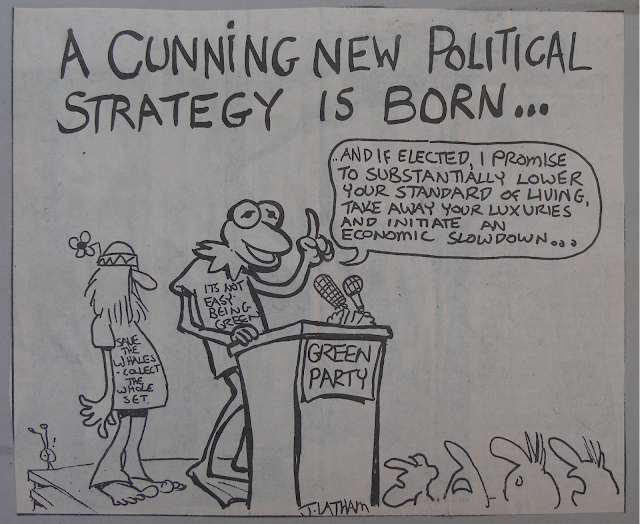
I have scrap books, this was in one of them.
 
As I said above, it's a subjective response. One of the things I don't like about editorial cartoons is that their primary objective is entertainment, not information. (That's a nice way of saying that many cartoonists are just paid to be smart asses.)

Having said that, it is true that a large part of what I said then and am still saying now gets this sort of response. All of us have to make a choice about what is or isn't important. And, I would argue, the things that really are important in life can be easily supplied without creating runaway climate change---but the frivolous, dumb things often cannot. Unfortunately, many people see this as an attack on people living a 'good' life. And that's what I want to talk about in this op ed: "Just what exactly is a 'good' life?"

&&&&

Recently I've noticed something jarring about CBC news coverage of the recent global spike in inflation. Let me paint a picture. I've seen news clips of:
  • someone complaining about the cost of airline travel: "$3000 return! That's five month's rent for me!" ($600/month rent---where the heck does he live?)
  • another person complaining about the cost of food---he's looking at watermelons in a grocery in January
  • a young guy complaining about gasoline costing $1.95/liter at CostCo and complaining---while filling up his huge gas-guzzling, immaculate (ie: not used to haul anything) pickup  

This isn't to say that I haven't seen news clips of people suffering real need. People are living on the street, food banks are emptying out, people working at several poorly-paid jobs that they drive to in decrepit cars. We have a lot of people who's heads---or even their nostrils---are just above the waterline and any inflationary turbulence risks drowning them. 

I'm not talking about these folks, I'm talking about the people who are complaining because they can't jet around the world on vacation, buy fruits and veggies that have been shipped thousands of miles, or, who drive in expensive, gas-guzzling ego props. And, I'm talking about the reporters on TV news that think these complaints merit time on the national news.

I'm old enough to remember when people didn't travel much. Indeed, in my grand-parent's generation most folks didn't travel at all unless they were going with a rifle on their shoulder or a carpet bag full of bibles (both scenarios we all can do without). In addition just about everything we ate had been raised within a very short distance of our home. We did drive gas guzzlers but only because back then all cars were---but not very far because even though fuel was cheap, we were poor. Besides, living on a farm there were always animals to feed and stables to clean.

What I'm trying to say is that people's expectations about what the "bare minimum" should be have expanded in some ways that I don't think are really healthy. This isn't an example of "old man Hulet" complaining about those "new kids" and their fancy toys. Instead, I'm saying that at least some of people's disposable wealth would be much better spent on different things than it is. That fancy new pick-up exists somewhat at the expense of a good public transit system. Those thousand mile watermelons are at the expense of people who have to go to food banks in order to not go hungry. And the money for those trips overseas would probably be better spent on building more social housing. 

The connection I'm drawing isn't clear-cut and obvious. I'm not saying Aunt Alice's trip to Italy involved dumping some stranger out on the street. If the connection were that clear people would probably be more aware of it. Instead, I'm saying that the society that creates the aspirational ideals of "travel broadens" and "whomever has the most toys when they die wins" is not the same one that would suggest "the existence of poverty is a stain on our entire community" and "taxes are the price we pay for a civilized society".

Maybe in a future Star Trek utopia people will be able to do whatever they want without bad consequences for other people. But that's not the world we currently live in. There are environmental consequences from the frivolous consumption of fossil fuels. And poverty is a result of wealth stratification. In a world without "replicators" and "transporters", for one person to have far too much someone else has to get by with less than enough. Surely it's obvious to anyone with eyes to see that our current society suffers from a systemic misallocation of resources.   

Actually I'd like to go beyond this and suggest that there is a deeper issue here. Consider the following short video clip of billionaires throwing skittles into each other's mouths and listen to the banter between each of them. 


This reminds me of every dumb, stoned road trip I went on as a young man. I, at least, had the excuse that I was young and knew nothing at all about the world around me. But these folks are titans of industry who have enormous control over the lives of other people. And with all that power at their finger-tips, they used a significant fraction of the world's resources to spin in free fall and throw skittles in each other's mouths.

This isn't just about "things", it's also about "experiences". I once met a young man who had a good unionized job working at a menial occupation. He was making a lot of good money. Did he save it for a home, business, education, etc? Not really. Instead, he got into the habit of flying around North America to attend Rolling Stones concerts. I often wondered what the folks who fought for the forty hour work week and unionization would have thought of someone who had gained so much from their sacrifice but used it in such a frivolous manner. Some experiences cost nothing except concentration, courage, and, effort (eg: building a union)---others can be bought with the swipe of a credit card. The former build character---the latter are just another type of conspicuous consumption. 

Lots of commentators have talked about the outrageous amounts of money wasted on space tourism, but I'd suggest that the big problem isn't the money, per se, but rather the interests of the people involved. (I certainly don't consider the astronauts and scientists who work in space to be frivolous people.) Ultimately it is pretty much the same thing as when middle-class types go to some warm clime to sit on a beach. Indeed, for people who have a lot less money than Bezos and company isn't taking a jet flight as tourists pretty much the same thing? It's just a way to burn through a significant fraction of their income with no particular value except to show that they can afford to do it. At best it's a form of low-brow entertainment---like watching children's cartoons or one of those terrible movies that is all about the special effects. At worst, it's just a way of showing off to the other people in your life. Can't we come up with something better to do with our time---something that doesn't involve destroying the planet and keeping a fraction of the population poor?

&&&&

Time for the begging bowl. Writing this blog is real work and I put a surprising number of hours into it. So if you can afford it, why not consider buying a subscription? Pay Pal and Patreon make it easy to do. (Thanks Carol for being so awesome!) And by doing so, you'll be making a concrete statement about what you do or do not think is important in this world. 

&&&&

Part of the problem, I believe, is that modern people lack the vocabulary to even conceive of or understand the issue I'm raising. Early Christianity had a language that dealt with something quite different, but in the same vein:

  • "Blessed are those who hunger and thirst for righteousness, for they will be satisfied."
  • "It is easier for a camel to go through the eye of A needle than for a rich person to enter the Kingdom of God!"
  • “If you want to be perfect, go, sell your possessions and give to the poor, and you will have treasure in heaven. Then come, follow me.”

I say different, because I'm not interesting in perpetuating the baggage that has become associated with some of the teachings in the Gospels

  • belief in God
  • original sin
  • the importance of belief in Jesus as the son of God
  • the resurrection
  • the virgin birth
  • the importance of the eucarist
  • life after death
  • Hell
  • etc

Instead I just want to focus on one particular thing: the importance of 'intangibles' in people's lives. This isn't the same as "the kingdom of God is within you" but---to paraphrase Mark Twain---something that "rhymes" with that notion.

I'm not sure if I can actually point directly to I'm talking about, but I think I can see the footprints it leaves in the lives of the people around us. For example, consider the care that many people put into their gardens, the food they prepare for their family, the charity work they do for the community, the hobbies they pursue, the political party they support. I believe I often see it in environmental protests. It's what inspires academics to spend hours and hours pursuing the exactly apropos quote for a paper or the experiment that explains the slight variance in a predicted outcome. 

I said that I cannot directly point to what I'm talking about, but only give indirect evidence. That's because those beautiful gardens, nice meals, etc, I mentioned above aren't the important point---they are just the result of what I'm talking about. Perhaps the best approximation I can come up with is to say that that what I'm talking about is something like what some people call being "spiritual"---as in the sense of "I'm spiritual, but not religious". (Most assuredly I am not suggesting that this is what all people mean when they say such a thing. But maybe some do.)

If a person hires an excellent gardener or cook, they do not partake of the spiritual dimension of exceptional gardening or food preparation. The spiritual dimension comes from the process of learning how to grow or cook something amazing. And you can't buy the personal satisfaction and growth that comes from really paying attention to what you are doing and learning about yourself and the world around you while doing so. That's a central part of the saying "the best things in life are free".

Over the last few months my wife and I have been working at improving our health through a dedicated regime of regular exercise plus a total rethink of our diets. We were stretching the other day and part of that involved going through a series of yoga "cat/cow" exercises. In the midst of it Misha called me out for the way I was executing a subtle detail of the "cow" move. She said I was "just doing it to get it over with". She was right and I quickly took advantage of the correction. 

I want readers to linger over that phrase "just doing it to get it over with". That's an important clue to large part of what I think is wrong in our society. Please note, I'm not fixating on the end result. It's true that if you put your heart and soul into doing things the best you can the results will usually be better than if you do a half-assed job. But beyond that, I'm suggesting that the more you put into what you do, the more personal fulfillment and personal growth you will get from the process.


(Of course this is only true up to a point and once certain other necessary criteria have been "checked off". I'm not suggesting that guards at concentration camps could find spiritual fulfillment through being the best sadists possible. Nor would I suggest that slaves should grow spiritually through being the best enslaved cotton pickers they can be. And many of the jobs people work at in our society are at best absurd and at worst harmful to the planet and other people. It's also very hard to find joy in work that results in exhaustion and barely keeps a roof over your head. This whole discussion is about one particular aspect of a huge complex, booming world. But it is an essential bit---and I don't think our culture gives it anything like the attention it deserves.)

&&&&

So what has this got to do with that speech I gave in Stratford 33 years ago? 

I hear a lot of people talk as if the key to environmental sustainability is to develop electric cars so people can still live the 'happy motoring' lifestyle, and, electric airplanes so we can have an environmentally safe Club Med. Anyone who's really tried to do the math on this sort of thing quickly realizes that this is not going to happen. But we can have an environmentally sustainable world with good public transit, where there are no beggars on the streets, and, people have a lot more opportunity to develop their creativity. There would be a lot fewer "things" and "tourism" in this world---but I believe there would be a lot more happy people. I also think that there could be a lot less poverty too. 

The problem is that the society we are living in now is incompatible with the one we could have according to the ideals I've expressed above. You can get there from here---but you have to be willing to leave here behind. It's easy for a cynic to make fun of any suggestion that we should try to change the world. (Hence the above editorial cartoon.) But someone has to make the effort to suggest things could be different if we really want them to ever be different.

&&&&

There's a Zen story that goes something like this. A poor, but happy monk was out one day gazing at the moon while meditating. A robber came by and ordered the monk to hand over his possessions, which he did. When the would-be thief realized that the monk was---if anything---poorer than he was, he threw everything down and wept bitterly about his lot in life and walked away. The monk looked at him with sadness and said "if I could, I would have given him the moon".

Our society is like that thief. I feels empty so it tries to steal the riches of the earth and take from future generations. But flying to other countries, eating foreign food, and, pimping our ride won't fill the holes in our hearts. But unfortunately, anyone who has found the answer to living a good life in harmony with nature will find it extremely difficult to help the others understand. 

And yet we still try---. 

Here's a statue of Ryokan, the actual monk of the Zen story.

&&&&
 

Furthermore I say unto you, the Climate Emergency must be dealt with!  


Monday, April 27, 2020

A Review of "Planet of the Humans", or, How Bad Can Doomer Porn Get?

The other day I got an email from a friend telling me about a new film that has been uploaded to YouTube and that he thought I might want to check out. It's Jeff Gibbs Planet of the Humans. For those of you who might not know, Gibbs is a film-maker who's been very involved with Michael Moore for many years. According to IMDb, he produced Fahrenheit 9/11, Fahrenheit 11/9, Michael Moore in TrumpLand, and, Bowling for Columbine---which were all Moore vehicles. Gibbs is also a musician and he helped with the soundtracks of Capitalism, a Love Story, Fahrenheit 9/11, and, Bowling for Columbine

Planet of the Humans promotional shot c/o Matthew Carey's blog Non Fiction Film.
From viewer's left to right: producer Ozzie Zehner, director Jeff Gibbs, and,
executive producer Michael Moore.

I found it to be an infuriating movie. In fact, I was so angry at it that I had to stop watching it after the first third and wait a day until I'd cooled off enough to finish it. 

Let me outline a couple issues that I had with it.

First, as near as I can tell, Gibbs plays fast-and-loose with the truth. Look at this clip from the film (it's a little over 30 minutes into the film).


The fellow he's talking to says that "some solar panels are built to only last ten years".  Think about that statement "some solar panels". Did you actually learn anything from it? Not really, because the important issue is "how many solar panels only last ten years?" I looked around and found out that the vast majority of solar panels last a lot longer than that---and the length of time that they do last keeps getting longer and longer as engineers get better at building them.

The first thing to understand is that "only last" doesn't mean that they melt into a puddle of goo after they've expired. Instead, the issue with solar panels is that their efficiency degrades over time. According to this 2014 article in Engineering.com titled What Is the Lifespan of a Solar Panel? by Tom Lombardo, the way we should understand a panel isn't "how long will it last?", but rather "how fast does the output degrade---under what conditions?"
there has been a general rule of thumb that says that Photo Voltaic (PV) panels lose 1% of their productive capacity per year. The National Renewable Energy Laboratory (NREL) performed a meta-analysis of studies that examined the long term degradation rates of various PV panels. They found that the 1% per year rule was somewhat pessimistic for panels made prior to the year 2000, and today’s panels, with better technology and improved manufacturing techniques, have even more stamina than their predecessors. For monocrystalline silicon, the most commonly used panel for commercial and residential PV, the degradation rate is less than 0.5% for panels made before 2000, and less than 0.4% for panels made after 2000. That means that a panel manufactured today should produce 92% of its original power after 20 years, quite a bit higher than the 80% estimated by the 1% rule.
Gibbs doesn't technically lie when he put in the quote that says "some solar panels are built to only last ten years" because I suspect that there are probably solar panels being made for something like lawn lights or a child's toy that this is true. But that's not relevant to the thesis of the film, and putting it in the film will confuse many casual viewers into thinking that PV panels are a scam. 

Moreover, Gibbs doesn't allow for the potential that PV panels can be recycled. According to this website, they can.

These are two different recycling process for two of the most common types of
PV panels: silicon-based ones on your left, thin-film on your right. 

&&&&

OK. Anybody can make a mistake. But how about this example? (It comes at a little over 42 minutes into the film.)


Basically, the intrepid film makers go to the one of the nine power facilities of the giant Solar Energy Generating System (SEGS) in California. The naive viewer of the above clip would think that the entire system has been shut down and removed. But as near as I can tell, that's simply not true.

According to a blog by Ketan Joshi, the facility is currently up and running---with no abandoned or non-functional parts. I went into Google Earth and looked up the "Solar Energy Generating System California", and got this screen grab. 

Here's a satellite image of the array in 2015.
The date of this photo that comes up with my Google Pro viewer (you won't see the date with the on-line version) is September 5th, 2015. There was also no mention of the SEGS system being dismantled in the Wikipedia article on it. Joshi's commentary on it is as follows: 
Without knowing when the footage was taken, the only likely explanation for this is the pair of dudes visited the site midway through the point at which one of the fields was being removed and replaced with newer models, something which has happened several times over the past few decades.
 &&&&

These are two examples that I've chosen to look into, but I suspect that there are lots of similar fibs, over-generalizations, and, dubious analogies. Gibbs uses what philosophers call "the Gish gallop". That's an informal logic error that happens when someone quickly throws a barrage of lies, half-truths, innuendos, etc, at someone and never allows him or her the time to think about the relative truth of what has been said. This turns on the fact that it takes a lot longer to analyze whether or not a specific statement is believable than it does to just say it. Gibbs says a lot of things in his film that I find hard to believe, but it has taken me quite a few hours to just deal with the two specific issues I've raised above. Most people don't have the time or ability to truth check what Gibbs is saying, so a lot of folks will simply take what he says at face value---which would be a very bad thing.

(If people are looking for a suggestion about how they should respond to this sort of thing, I'd recommend something that you might want to call "the Hulet hammer". That is, when you find someone like Gibbs playing "fast and loose" with the truth, simply decide that you will never listen to a word he says ever again. It's true that even a stopped clock is right twice a day, but the problem is that unless you have a properly functioning clock too, you won't be able to tell exactly what times of day the stopped clock is right. Frankly, I "hammered" Michael Moore a long time ago, but when my friend contacted me, I thought I might get an op ed out of it.)

&&&&

The really annoying thing about Gibbs is that I think that I agree with the point he was trying to make, but he did such an appallingly bad job of saying it, that it totally destroys the utility of the film. Here's a clip from an interview that I found on line.


He says that the ultimate problem that we are facing is too many people consuming too much and makes the bizarre claim that "we don't even have a name or words for this". Well, yes we do---we call it "overpopulation" and "greed".

There's nothing in this that I disagree with. But that message gets damaged by the out-and-out bullshit that he spreads all over the film. If someone puts as much misleading nonsense in his message as Gibbs does, the only rational thing to do is ignore everything he says. Moreover, he's just created a powerful resource for people who want to stop the government from actually doing anything about the Climate Emergency. You better believe that clips of his film are already being shared around the "alt-right" networks as proof that "so-called climate change is a socialist plot", as Stephen Harper used to say. 

&&&&

There are other things that are problematic about this film. 

He does the stupid "gotcha quotes" thing when he approaches people like Al Gore and Bill McKibben. If he'd made the effort to really try to get to know these people, he'd probably realize that environmental leaders tend to have an extremely deep and nuanced understanding of these issues. But they are heavily constrained by the system that they inhabit. 

I've known a fair number of local "celebrity environmentalists" and the majority of them are far, far, far more radical in their assessment of the problems we face than you would ever know from what they say in public. That's because they are constrained by the institutional situation they find themselves in. One of Leonard Cohen's poems has the lines "They sentenced me to twenty years of boredom / For trying to change the system from within." That's what it's like to work as an elected green politician or manage an environmental Non-Governmental Organization (NGO). You have to dumb-down your message to the point where you often feel that you are being dishonest. That's not because you are a bad person, it's because so many people you need to donate money or support your legislation will simply tune you out if you try to educate them about how bad things really are and what we need to do if we are going to turn things around. 

People in positions like this don't have the luxury of following the facts where they lead them. That's something that a journalist like me or a film maker like Gibbs can do. The problem with Gibbs is that for some reason he decided that it was better to cite a convenient falsehood than actually get to the nub of the problem. 

&&&&

Think about this, if you will. This godawful stinker of a movie will be seen by a lot more people than this review. That's because it appeals to what's worst in people. Well, why not show the world that instead you want to see well-researched, thoughtful analysis instead? You can do that by subscribing through Patreon or Pay Pal. A dollar a month is fine, and you will be showing the world that you think there should be more than just sensationalist crud on the Web. 

&&&&

There's another element to this that needs discussing. Gibbs---like Moore---doesn't believe in rational discourse. Instead, they absolutely blast viewers with emotional images. For example, he talks about using waste fat as part of bio-fuels and shoves in this short clip to illustrate what he's talking about. 


Maybe it's because I've studied philosophy, maybe it's because of my childhood being surrounded by out-of-control, hyper-emotional, angry people, but I do not think that any issue is served by an empty appeal to emotions. That's what demagogues do to whip the mob into a frenzy. 

This isn't to say that there is no place for emotions. I'm a fairly emotional person myself. And I think Greta Thunberg's emotional tongue-lashings of the "powers that be" have done a lot of good. But the difference is that young Greta is real in a way that I suspect Gibbs can never be. What she says is spontaneous, honest, and, from the heart. Gibbs' movie is contrived, gratuitous, and, artificial. He didn't just say what he feels---he sought out some sort of really nasty footage from a dead stock operation, contacted the person who owns the rights, and, paid them to be able to put it in the film. 

That's not about letting the public know about the Climate Emergency. It's about artificially exciting people's emotions to create an extremely heightened sense of concern about the future. It's exactly the same thing that a pornographer does when he records images aimed at exciting the sex drive of jaded people. Jeff Gibbs is a pornographer and Planet of the Humans is doomer porn. 

He suggests that what he is trying to do is "create awareness". 


There is a common belief among some people that if you just show people how tremendously awful things are, they will change the way they act. I'm of the opinion that that doesn't work. Instead, making people feel bad about the future, IMHO, just makes people "shut down" and disengage. Our media is full of stories about how bad things are, but what is lacking is a description of an alternative future where things are better and a serious road map that outlines how we can get from here to there. That's the sort of movie I would have liked to see. Unfortunately, I don't think Gibbs (or Moore, for that matter) are good enough film makers to do such a thing. Too bad. 

&&&&

This is getting a bit long, so let me leave Gibbs at this point and briefly mention something that we should all be thinking about right now. 

Up until about two months ago I don't think many people believed that a nation could "turn on a dime" and totally change the way it does things. Well, almost all the governments of the world were told by their scientific advisers that a new disease had emerged that was a threat to a great many people. And almost all the governments decided to do something that had never happened before---they asked their societies to shut down their economy. Most citizens gladly went along with the quarantine orders. And most governments have opened up their purses to help many of the people hardest hit by the economic "freeze". In the space of a couple weeks our societies went onto a war footing. 

But this is the strangest "war footing" that the human race has ever seen. We didn't fly in planes, we didn't drive our cars, we didn't do much of anything that really wasn't about having enough to eat, keeping a roof over our heads, and, helping sick people. The result was a dramatic improvement in the environment and I believe that a great many people have also redefined what is important in their lives. 

I have hope that the Neo-Liberal consensus is gone and it will never return. We now know that it is possible for the population to be mobilized by strong leadership to do great things. And if we can do it for COVID-19, we can do it for climate change. Gibbs is right, technology will not "save us" as we go through the 21st century bottle-neck. But public mobilization using appropriate technology can. Unfortunately, I think Gibbs doesn't understand enough about anything to be any help in getting people to change their behaviour. Instead, I think his film will probably be more of a hindrance. It deserves to be quickly relegated to the dust heap of history. 

&&&&

Moreover, I say onto you, the Climate Emergency must be dealt with!


Friday, January 31, 2020

The Imitation Game

I've been researching an article about Eugenics in Ontario based on an interview I did with a curator at the Guelph Civic Museum and as usual, I've begun to obsess about about the issues that it raises. At the same time, I recently rewatched a movie about the computer pioneer Alan Turing and his work for British Intelligence during WWII. It's titled The Imitation Game and it focuses mostly on the personal life of Turing, which raises some pretty important issues that our entire society is currently dealing with. 

This is implied by the title and high-lighted in the pivotal interview with a police detective who arrests him for being gay and ultimately destroys his life simply because it's "the law". The key issue is that very many people in our society have to imitate an ideal that somehow or another has become a key part of their survival. If you can't play the role and dance to the right tune, your parents, your boss, the police, or someone else in the machinery of life will crush you like a bug. Luckily I can add a clip from the movie where the amazing Benedict Cumberbatch---as Alan Turing---talks about his famous "Turing test". This test is a way of trying to figure out if a computer is "conscious", "thinking", or, "aware" like a human being. 

In the movie, this is a metaphor for how one person relates to the other. In the specific case where the police detective is literally putting Turing's life on trial, he is trying to figure out if Cumberbatch's character is a "real human being" (ie: someone he should care about and protect) or if he is "just a poofter" who deserves to be ground under the heel of the criminal justice system. In a reverse sense, Turing is trying to figure out if the detective is a sensitive, intelligent being or else a macho robot who has no problem with destroying someone else's life simply because he is different. Unfortunately, the detective fails the test and can't understand that Turing is really a human being instead of just a two-dimensional, cartoonish "pervert".


Turning failed in his attempt to stay "in the closet" and as a result ended up losing his university position, was "chemically castrated", and---possibly---committed suicide as a result. Hardly what I'd call proper treatment for all the service he'd rendered the country during the war.

&&&&

I'm going to be honest in this oped. For most of my life I've thought that things like gay rights are fundamentally a distraction from dealing with more important stuff like climate change. My simple calculus was that discrimination sucks, but people have been surviving it for thousands of years. But climate change will totally screw over the entire human race, minorities and all. So I thought "let's save the entire human race first before we fixate on these lessor issues". Indeed, sometimes I thought the elites were fixating on gay rights because they are something that can easily be accommodated without threatening the existing economic and social structures that are stressing our ecosystem to the breaking point.

This point of view is shifting, though. For one thing, being somewhat engaged with the "New Green Deal" folks has opened my eyes to the idea that we are never going to get enough "buy in" from the general public unless we are willing to bring in the masses of people who have supported right-wing populists like Donald Trump, Boris Johnson, etc.

Unfortunately, a lot of those folks have already bought the line that helping people in distress is part of the problem, not the solution. But I think that part of this anger comes from feeling that all the support being supposedly "lavished" on gays, refugees, minorities, etc has meant that nothing is being done for them. As a matter of fact, I do think that there are legitimate complaints being raised---they are just being aimed at the wrong people. Immigrants and gays didn't get rid of all the good jobs and punch rents through the roof. But no one other than the populists seem to be willing to talk about those particular things and posit the sorts of radical solutions that a lot of voters "feel in their guts" as being necessary.
In practical terms, this played out with Hilary Clinton getting the Democratic nomination instead of Bernie Saunders, which meant that Donald Trump was running against a candidate who seemed to believe that everything in the USA is just peachy the way it is. If no one else wants to even admit that you have a problem, then the guy who says he has the answer is the only game in town---no matter how lame that answer really is.  
I think that "progressive" people need to come up with answers to the things that are bugging at least a significant fraction the folks supporting right wing populism.

But the research I'm doing with regard to eugenics has got me thinking that the real problem is that the only way we are going to get real consensus in society is if we finally stop forcing people to play that damn "imitation game".

&&&&

I wonder if part of the reason why so many people who read this blog won't subscribe and help pay for it is because in some way they think that I am a "stinking capitalist pig"? How about I turn this idea on it's head? The business model I'm following is that I am offering an important public service to the community for free. Nothing is behind a pay wall, so cost is not an issue for being able to read it if you have access to the web. (Which almost everyone does because of the free access computer pools at the public and university libraries.) If you think that local, in depth coverage of news is an important public good, I'm inviting you to use Patreon or Pay Pal to help support this public good. (Thanks to the anonymous individual who gave me money via some third party company I'd never heard of before.) 

&&&&

I've written a bit about this in the past in other venues. For example, here's a post in another blog where I discuss the idea that women have to always smile at everyone they meet. That's just as much a part of the "imitation game" as gays being in the closet. It's also part of what men go through when they are taught to be "tough" and "stoic". These things cause real problems in people's lives. Women don't get listened to, and men end up being emotionally fragile people who's only way to deal with unbearable situations is to explode into violence. (We all know how much these two strategies are helping the human race deal with it's problems!)

There's a deeper level to this than just the suffering we inflict upon individuals who can't dissemble enough to "pass" as fitting the artificial definition of humanity that our current society is built around. The problems we face as a species all seem to come down to one macro problem---we don't understand subtleties very well. Every economic decision we made is all based on money and any consideration of how it affects people or the environment rarely makes it to the board room where all the decisions get made. Our criminal justice system is based on the idea that people freely choose to commit crimes without any understanding of how important our previous history is to the choices we make. We compound this idiocy by then assuming that if we act viciously enough towards incarcerated individuals they will miraculously become saints by the time their sentence expires.
We smash, we destroy, we act out, we "dumb down", we ignore, we force people to "shut up", etc, etc. The problem is that if we continue to act like ignorant boobs we simply cannot have 9 billion people using modern technology and hope to have anything like a functioning ecosystem. We can no longer force the wide variety of human beings to act out an "imitation game" where they try to act as if the tinker-toy culture we have inherited makes any sense at all in the time of climate change, CRISPR, artificial intelligence, atomic weapons, etc. Just as we have to learn to embrace complex ecosystems instead of boring monocultures; we also have to learn to embrace all of humanity in it's diversity. People who think differently have a lot to offer us, if we'd just listen to them, to leave them their own corner of society instead of continuing to smash their round pegs into square holes.
Sometimes it is the people no one imagines anything of
who do the things that no one can imagine.
Alan Turing, c/o IEEE Spectrum.

Thursday, December 12, 2019

Public Mobilization

In the last few weeks I've had some experiences that I think might indicate a pretty important issue that I think just about everyone else seems to have missed. I thought a quick discussion of this might help others articulate something that might be on the tips of their tongues without being able to clearly identify the problem.

&&&&

As regular readers might remember, I wrote a post a while back explaining just what "being on a war footing" meant during WWII. The idea is that we could speed up our efforts aimed at avoiding catastrophic climate change if the governments of the world got off their collective butts and started acting like they really thought that we are in a climate emergency. As a result, I've become something of a Diogenes wandering through Guelph trying to find a politician or bureaucrat who wants to put some effort into mobilizing the public to deal with the climate emergency.

Vainly looking for an official in support of public mobilization?
Diogenes Looking for a Man by Johann Heinrich Wilhelm Tischbein.
Public Domain image c/o the Wiki Commons. 

I made this question a couple weeks ago at a private meeting between Lloyd Longfield and a delegation from the Green New Deal and also a couple nights ago to the past Environmental Commissioner, Diane Saxe, during a city event. In both cases the result was the startled look of a deer in the headlights of an oncoming car plus a question to the effect of "what do you mean?". I don't think I was totally out to lunch, however, because in both cases at least one other person referred to my question in their's---which suggests to me that I'm not the only one wondering why people of good will in positions of authority simply won't try to engage the public to help with the climate emergency.

Diane Saxe: "Public Mobilization?
What the heck does that mean?"
Photo by Ontario government,
c/o Wiki Commons.
Don't get me wrong. My read of both Lloyd Longfield and Diane Saxe is that they are both really good people who care about the climate emergency. But as I see it, they are both people who come from a background that specifically selects against people who think about how to mobilize the public to deal with a specific issue. 

From what I've heard Mr. Longfield say, it seems that he comes from a background in engineering and business. Those are both fields where communicating with the public is not nearly as important as dealing with a specific problem that you solve either through mathematics and research, or, one-on-one deal making. 

Similarly, my understanding is that Ms. Saxe comes from a legal background where she worked as a mediator. And the absolute last thing that mediators ever want to do is draw the public into the conversation. And, as I've pointed out with an earlier post titled What is an Environmental Group?, most environmental organizations consist of a small number of professionals who fundraise for their campaigns either through a professional fundraising company, solicit donations from a small number of hyper-rich donors, or, sub-contract for the government. So her experience with environmental organizations would similarly ill-prepare her for understanding how to mobilize the public in favour of a specific issue. 

Another aspect of this comes from a future story that I'm preparing about parliamentary reform. In
Michael Chong:  "Don't expect modern
parties to nominate rabble rousers!"
Photo c/o his office. 
conversation with Michael Chong he pointed out that the independence of local Electoral District Associations in Canada has withered away to the point where the party leader holds all the real power when it comes to nominating candidates. This means that no one who amasses a profile and following in a riding on the basis of engaging the public would ever get a nomination---simply because that would almost by definition mean that she is not a "team player" who would willingly submit to party discipline. 

And if almost no one in Parliament is going to understand and support the idea that the average Canadian needs to "get riled up" to avoid catastrophic climate change, then there certainly aren't going to be any bureaucrats who will either. I worked for decades at the University of Guelph---which I nicknamed "the last outpost of the Soviet Union"---so I understand the bureaucratic mindset very well. The absolute primary responsibility of anyone in any sort of institution is "cover your butt". Generally the first response of an appointed official is to limit public engagement through things like controlling their access to information---not encourage them to actually do something!

&&&&

What's especially frustrating about this refusal to use one of the biggest weapons in the government arsenal is the fact that the people who want to make the world into a fiery inferno have no such qualms. Doug Ford is putting those Dao-cursed stickers on gasoline pumps.

Doug Ford has no problem at all with public engagement aimed at
helping the human race commit suicide! Image from a government website. 

And, of course, Jason Kenney---the Fuhrer of Alberta---announced yesterday that $30 million is going to be spent creating a propaganda machine touting the "true story" of how the tar sands are nothing but butterflies and rainbows. This is their first creation:


The problem with progressive political parties refusing to do any public mobilization is that the forces of evil have no similar qualms. And if you leave the field open, a lot of people will simply accept Ford and Kenney's nonsense if they don't see any push back. This creates a natural "base constituency" that will vote against any political party that does try to do something to stop total catastrophe. By not pushing the case for rapid mobilization to end fossil fuel use, progressives simply don't build their own core constituencies.

&&&&

So what would it look like if the government actually tried to mobilize the public to fight climate change? There is the example from WWII---.

For example, the government could try to cut fossil fuel use by encouraging car pooling or using public transit.

How about "When you ride alone you help destroy
your children's future"?
Or, it could create green future bonds to pay for programs like electrified public transit.

Children in a blighted, over-heated landscape?
Don't let your children fry, buy transit bonds!

How about a campaign aimed at encouraging people to invest in a greater efficiency life-style in order to create a fossil-fuel free future? 


People might object that I'm just rehashing stuff that's already been done. We have had energy-star appliances, financial incentives to put up solar panels, etc. But none of these have been sold emotionally. Instead, they've all been marketed through financial inducements. Indeed, the Liberals have made no attempt whatsoever to say that dealing with climate change is the right thing to do, or, that we have a moral imperative to do it---instead, ordinary folks could be excused if they thought that the entire thing just comes down to the carbon tax.
&&&&

I'll admit that I'm a little angry in this post. I've been getting increasingly steamed over the last few weeks as I see person after person refuse to admit the gravity of the situation that the human race is facing. People should throw their "objectivity" and "manners" out the window and tell the flat-out truth that fatuous dorks like Jason Kenney and Doug Ford are "fiddling while Rome burns". 

An additional minor truth that I am angry about is that people should be willing to pay for their news if they don't want to live on a diet of pablum and spin. If everyone who reads local news were to contribute a dollar a month to the news sources they like, Guelph could have a rich and lively independent news scene. Instead, most folks are content to just get the free stuff and let the advertisers tell you what they want you to hear. 

The difference is that if you pay for the news, you are the customer. If you get it for free, you are the product that the publisher sells to the advertiser. 

What would you rather be? Patreon and Paypal make supporting indie media very easy. 

The added benefit from this business model is that your news doesn't hide behind a paywall, which means that people who genuinely can't afford to support it still get it for free. 

&&&&

I get it. If you've spent your entire life looking at numbers, mediating disputes, negotiating contracts, implementing government policies, etc, emotions are scary, scary, scary. Emotional people yell at you. They don't make sense. They just make everything difficult.

But emotions are what get people to actually change their behaviour. And we can't solve the climate crisis simply through technology. People are going to have to change the way they live their lives. We can't just switch out internal combustion engines and replace them with electric ones and continue the "happy motoring" lifestyle. Increasing numbers of people will have to accept that they are going to have to live in higher density housing serviced through public transit. (Yeah---no backyard for the kids to play or drives in the country. Get used to it!) We won't be able to fly overseas every year or even every other year anymore. Things will have to change, and while a carbon free life doesn't have to be any less convenient or pleasant, a lot of people are very afraid of any significant change in their lives. If we don't work at emotionally engaging with people, we are not going to get them to commit to the program.

Instead, what I've heard over, and over, and over, and over, and over, and over, and over, and over, and over, and over, and over, and over, and over, and over, again for about 30 years is that "we have to make baby steps" and that "people can't handle the truth". Well, we are getting very close to "taking baby steps" over a damn cliff! It's time to be honest and emotional with the public. And the government needs to be part of that effort.

When other people pushed Diane Saxe on the need to engage the public, she did suggest that there are "groups" out there that can do that. She lauded "Fridays for the Future". But that's a bloody cop-out. In WWII no one in the government suggested that if we really wanted to stop Hitler we needed to get the school children out making a fuss. Instead, the government made the decision that they needed to get people cranked-up so they'd buy victory bonds, recycle scrap metal, grow their own veggies, accept rationing, etc. And they hired the very best people from the artistic community to fashion the images and ideas necessary to get everyone "with the program". (For crying out loud, the BBC even hired George Orwell to write propaganda for their Eastern service.)

We live in a sea of advertising. Every advertisement that people watch is implicitly telling folks that "everything" is OK. That there's no need to worry. Well, that's a damn lie. And we need some force in society to push back against this mountain of misinformation. And the only public force large enough to do this is the government. So if you have a chance to "bend the ear" of a politician, I'd suggest you bend it in the direction of trying to actually using public campaigns to get people emotionally engaged with the climate crisis. Because I simply do not think that we will be able to actually get the job done unless we do.

&&&&

Furthermore I say onto you, we need to deal with the climate crisis! 

Friday, August 23, 2019

Too Many Airplanes

Greta Thunberg was recently in the news because she decided to travel by
Greta Thunberg is sailing instead of flying.
Photo by Jan Ainali, c/o the Wiki Commons.
sailboat instead of airliner to attend a environmental event in New York. The point she wanted to highlight is the impact of the air industry on climate change. As such, she was following in the footsteps of Mohandas Gandhi who also sought to mobilize public opinion through his own personal behaviour. (That is why he wore a loin cloth and was often seen sitting at a spinning wheel making thread. He was suggesting that Indians should support their local craft industries instead of British imports.)

She has been taking heat over this by "the usual suspects" who feel threatened by the idea that people are taking too many flights around the world and that maybe we need to rethink this behaviour.

I've always been somewhat skeptical about the idea that it is a good thing to have hordes of people flying all over the place. Generally I keep my thoughts to myself, however, because that is such an unpopular viewpoint in my social milieu and I don't want to always be the guy who "puts the turd in the punch bowl". But having said that, I thought I'd give this story another look. And, unfortunately, this is one of those ones where a little research has shown things to be far worse than I originally suspected.

I looked into a fact sheet put out by the International Air Transport Association (IATA) and it turns out that there were a jaw-dropping 4.4 billion discrete trips by an individual on an airplane in 2018. (This was one of those times where I did a lot of double and triple checking for the number---because I originally couldn't believe that it was true.) This resulted in 95 billion (US, I assume) gallons of fuel being burned, which released 905 million tonnes of CO2 into the atmosphere. 

This isn't a static number, either. It turns out that there was a 7.4 % increase in Revenue Passenger Kilometres (RPK) in 2018 over the year before. (This is a more useful term than just the number of fliers, because this adds in an idea of the length of the trip as well as the bare number.) This number has been going up by leaps and bounds---an average of 7% for each of the last six years. Just to put things in perspective, if we convert this 7% growth rate to a "doubling" number---using "the rule of 70"---we come up with a doubling of the air industry in only 10 years. Presumably that would mean that at the current rate of expansion air travel could result in 190 billion gallons of fuel burned and 1.8 billion tonnes of CO2 release in the year 2029. (I think Greta might be onto something here---.)

Statistics Canada has some numbers about what our nation is doing. Here's a graph of air travelers by year.


Another interesting factoid says that Canadians logged in 192.8 billion passenger kilometres in 2016, which was an astounding 9.5% increase from 2015. (If this seems odd given the above bar graph, remember that "passenger kilometres" measures the distance traveled. If the same number of people travel longer distances, the problem just got worse.)

Let's put this into a perspective. The IATA says that in 2016 the entire world logged in 3.8 billion trips, and---from the above Statistics Canada graph---Canadians logged in something like 80 million. In 2016 the world population was something like 7.4 billion and Canada's was 35 million. So Canada's share of trips by plane was 2.1% of the trips, even though we only had 0.47% of the world's population. Yet another example of Canada punching above it's weight on the world's stage!!!!

&&&&

If you think that this blog is a valuable resource for you to read, why not subscribe? It's really easy to do. And when I say that I'm fine with people only paying a buck or two per month I really mean it. I only have one person who subscribes that much---everyone else puts in five or ten a month. That's appreciated, but if a lot of people would just send in a buck a month that could build a significant subscription base. Both Patreon and Paypal are set up to let people do that---so why not try it?

&&&&

I mentioned above that I'm not very popular with people when I talk about this
Mark Twain, photo by A.F. Bradley.
Public Domain c/o Wiki Commons.
sort of thing. I think that that's because it is an article of faith among baby boomers that "travel broadens".
“Travel is fatal to prejudice, bigotry, and narrow-mindedness, and many of our people need it sorely on these accounts. Broad, wholesome, charitable views of men and things cannot be acquired by vegetating in one little corner of the earth all one's lifetime.”
Mark Twain
The problem with this quote is that it is total nonsense. The actual physical movement of a human being from place to place has zero influence on their mind. I first figured this out by talking to sailors. You might think that traveling around the world on a ship would help people learn about other cultures. In fact, for many of them just go to the nearest bar and stay there until it's time to ship off again. And how many people's idea of travel boils down to not much more than laying on a beach reading mystery novels and sucking down drinks with tiny paper umbrellas? Of course, there are exceptions. But those come from the individual, not the mere act of burning jet fuel and hurtling from one country to another at high speed.

A passing acquaintance with history will tell you that it's always been thus. Yes, there are folks who've had their minds broadened while traveling. But that says more about them than their months spend in a ship or on horseback. If this wasn't the case, what explains the hordes of "Colonel Blimps" who managed the colonial empires of the world? Or the missionaries who devoted their lives to spreading the blight of Western sexual hangups to "primitive peoples"? Shouldn't all these folks have had their "minds blown" by living in a totally different culture for extended periods of time? If "travel is fatal to prejudice, bigotry, and narrow-mindedness" where the Hell did all that Western "cultural imperialism" come from?

&&&&

How about we come up with a new and better quote for someone to use in this context?
The world has too many people travelling around trying to find a good place to visit---and not enough staying put to build a good place to live.
Frank De Jong, former leader of the Green Party of Ontario

Frank De Jong, with his favorite transportation device.
Photo by Shaun Merritt, c/o Wiki Commons.

&&&&

One last point.

When I mention the impact of any personal behaviour on the macro level, I am not suggesting that anyone who actually does this thing is evil. Nor am I saying that there is no solution unless everyone spontaneously changes their behaviour. No social issue every changes because people all individually stop choosing to do some particular act. Slavery, using ozone destroying chemicals, discrimination against gays, etc, all needed to be dealt with through government regulation.

But there is a relationship between what people personally choose to do, and what the government will eventually end up regulating. If almost everyone flies around the world on a regular basis---for business, family matters, tourism---politicians are going to avoid creating any sort of policy that will cut down on a voter's ability to do so. That means that at least some people have to be willing to start a debate about whether or not something is a good idea. And at least a visible minority of people have to be willing to change their minds about this sort of thing. If they don't, no politician with any hope of getting elected will ever be willing to take it on.

We need people like Greta Thornberg---who now has the public eye---to publicize this important issue. Unfortunately, a lot of the people I know who are leading the fight against climate change are also products of the "boomer generation" and accept as a rock-hard, totally not-to-be-debated, article of faith that "travel broadens the mind" and they adamantly refuse to even contemplate the idea that there should be some reduction in the amount of jet travel. Frankly, I'm appalled at the number of Greens, "climate activists", "progressive politicians", etc, who think nothing of flying all over the place to go on personal vacations or to conferences with marginal importance. This isn't because I think that they are "evil", or that they in particular are going to personally destroy the planet---but because the optics are horrible and it dramatically undermines their moral authority when it comes to advocating for policies aimed at lessening humanity's carbon footprint. And that weakens their ability to influence government policy.

&&&&


Furthermore, I say onto you the Climate Emergency must be dealt with!