Bill Hulet Editor


Here's the thing. A lot of important Guelph issues are really complex. And to understand them we need more than "sound bites" and knee-jerk ideology. The Guelph Back-Grounder is a place where people can read the background information that explains why things are the way they are, and, the complex issues that people have to negotiate if they want to make Guelph a better city. No anger, just the facts.
Showing posts with label Party Politics. Show all posts

Monday, May 30, 2022

What Exactly is a Good Life?

Back in 1989 (wow, 33 years ago) I was asked to go to Stratford Ontario to give a public lecture about the Green Party. I don't really remember much about the event, but I probably gave my standard talk about how environmental concerns will grow larger and larger over our lifetime and how citizens should start taking them more seriously. If we do this, I would have argued, we will find that a great many things that we then found tremendously important would have become of far less concern. I also would have said that some of the things that we will find not as important will be economic growth and a rising "standard of living". Finally, I probably mentioned something to the effect of we can have all the really important things in a sustainable society such as friendship, artistic expression, justice and equality, scientific exploration, etc---but we cannot afford much of the frivolous stuff like tourists flying all around the world and engineering our towns and cities around the automobile.

As I said, I don't remember any of my specific language, but I do have one subjective impression of what was said---I kept a copy of an editorial cartoon from the local paper that was inspired by my talk.
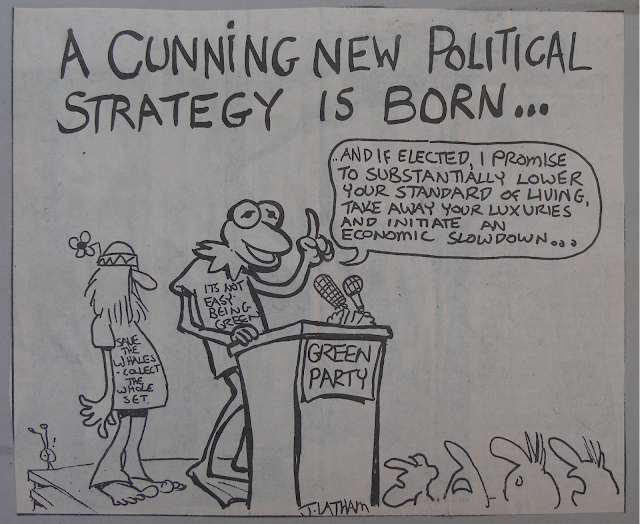
I have scrap books, this was in one of them.
 
As I said above, it's a subjective response. One of the things I don't like about editorial cartoons is that their primary objective is entertainment, not information. (That's a nice way of saying that many cartoonists are just paid to be smart asses.)

Having said that, it is true that a large part of what I said then and am still saying now gets this sort of response. All of us have to make a choice about what is or isn't important. And, I would argue, the things that really are important in life can be easily supplied without creating runaway climate change---but the frivolous, dumb things often cannot. Unfortunately, many people see this as an attack on people living a 'good' life. And that's what I want to talk about in this op ed: "Just what exactly is a 'good' life?"

&&&&

Recently I've noticed something jarring about CBC news coverage of the recent global spike in inflation. Let me paint a picture. I've seen news clips of:
  • someone complaining about the cost of airline travel: "$3000 return! That's five month's rent for me!" ($600/month rent---where the heck does he live?)
  • another person complaining about the cost of food---he's looking at watermelons in a grocery in January
  • a young guy complaining about gasoline costing $1.95/liter at CostCo and complaining---while filling up his huge gas-guzzling, immaculate (ie: not used to haul anything) pickup  

This isn't to say that I haven't seen news clips of people suffering real need. People are living on the street, food banks are emptying out, people working at several poorly-paid jobs that they drive to in decrepit cars. We have a lot of people who's heads---or even their nostrils---are just above the waterline and any inflationary turbulence risks drowning them. 

I'm not talking about these folks, I'm talking about the people who are complaining because they can't jet around the world on vacation, buy fruits and veggies that have been shipped thousands of miles, or, who drive in expensive, gas-guzzling ego props. And, I'm talking about the reporters on TV news that think these complaints merit time on the national news.

I'm old enough to remember when people didn't travel much. Indeed, in my grand-parent's generation most folks didn't travel at all unless they were going with a rifle on their shoulder or a carpet bag full of bibles (both scenarios we all can do without). In addition just about everything we ate had been raised within a very short distance of our home. We did drive gas guzzlers but only because back then all cars were---but not very far because even though fuel was cheap, we were poor. Besides, living on a farm there were always animals to feed and stables to clean.

What I'm trying to say is that people's expectations about what the "bare minimum" should be have expanded in some ways that I don't think are really healthy. This isn't an example of "old man Hulet" complaining about those "new kids" and their fancy toys. Instead, I'm saying that at least some of people's disposable wealth would be much better spent on different things than it is. That fancy new pick-up exists somewhat at the expense of a good public transit system. Those thousand mile watermelons are at the expense of people who have to go to food banks in order to not go hungry. And the money for those trips overseas would probably be better spent on building more social housing. 

The connection I'm drawing isn't clear-cut and obvious. I'm not saying Aunt Alice's trip to Italy involved dumping some stranger out on the street. If the connection were that clear people would probably be more aware of it. Instead, I'm saying that the society that creates the aspirational ideals of "travel broadens" and "whomever has the most toys when they die wins" is not the same one that would suggest "the existence of poverty is a stain on our entire community" and "taxes are the price we pay for a civilized society".

Maybe in a future Star Trek utopia people will be able to do whatever they want without bad consequences for other people. But that's not the world we currently live in. There are environmental consequences from the frivolous consumption of fossil fuels. And poverty is a result of wealth stratification. In a world without "replicators" and "transporters", for one person to have far too much someone else has to get by with less than enough. Surely it's obvious to anyone with eyes to see that our current society suffers from a systemic misallocation of resources.   

Actually I'd like to go beyond this and suggest that there is a deeper issue here. Consider the following short video clip of billionaires throwing skittles into each other's mouths and listen to the banter between each of them. 


This reminds me of every dumb, stoned road trip I went on as a young man. I, at least, had the excuse that I was young and knew nothing at all about the world around me. But these folks are titans of industry who have enormous control over the lives of other people. And with all that power at their finger-tips, they used a significant fraction of the world's resources to spin in free fall and throw skittles in each other's mouths.

This isn't just about "things", it's also about "experiences". I once met a young man who had a good unionized job working at a menial occupation. He was making a lot of good money. Did he save it for a home, business, education, etc? Not really. Instead, he got into the habit of flying around North America to attend Rolling Stones concerts. I often wondered what the folks who fought for the forty hour work week and unionization would have thought of someone who had gained so much from their sacrifice but used it in such a frivolous manner. Some experiences cost nothing except concentration, courage, and, effort (eg: building a union)---others can be bought with the swipe of a credit card. The former build character---the latter are just another type of conspicuous consumption. 

Lots of commentators have talked about the outrageous amounts of money wasted on space tourism, but I'd suggest that the big problem isn't the money, per se, but rather the interests of the people involved. (I certainly don't consider the astronauts and scientists who work in space to be frivolous people.) Ultimately it is pretty much the same thing as when middle-class types go to some warm clime to sit on a beach. Indeed, for people who have a lot less money than Bezos and company isn't taking a jet flight as tourists pretty much the same thing? It's just a way to burn through a significant fraction of their income with no particular value except to show that they can afford to do it. At best it's a form of low-brow entertainment---like watching children's cartoons or one of those terrible movies that is all about the special effects. At worst, it's just a way of showing off to the other people in your life. Can't we come up with something better to do with our time---something that doesn't involve destroying the planet and keeping a fraction of the population poor?

&&&&

Time for the begging bowl. Writing this blog is real work and I put a surprising number of hours into it. So if you can afford it, why not consider buying a subscription? Pay Pal and Patreon make it easy to do. (Thanks Carol for being so awesome!) And by doing so, you'll be making a concrete statement about what you do or do not think is important in this world. 

&&&&

Part of the problem, I believe, is that modern people lack the vocabulary to even conceive of or understand the issue I'm raising. Early Christianity had a language that dealt with something quite different, but in the same vein:

  • "Blessed are those who hunger and thirst for righteousness, for they will be satisfied."
  • "It is easier for a camel to go through the eye of A needle than for a rich person to enter the Kingdom of God!"
  • “If you want to be perfect, go, sell your possessions and give to the poor, and you will have treasure in heaven. Then come, follow me.”

I say different, because I'm not interesting in perpetuating the baggage that has become associated with some of the teachings in the Gospels

  • belief in God
  • original sin
  • the importance of belief in Jesus as the son of God
  • the resurrection
  • the virgin birth
  • the importance of the eucarist
  • life after death
  • Hell
  • etc

Instead I just want to focus on one particular thing: the importance of 'intangibles' in people's lives. This isn't the same as "the kingdom of God is within you" but---to paraphrase Mark Twain---something that "rhymes" with that notion.

I'm not sure if I can actually point directly to I'm talking about, but I think I can see the footprints it leaves in the lives of the people around us. For example, consider the care that many people put into their gardens, the food they prepare for their family, the charity work they do for the community, the hobbies they pursue, the political party they support. I believe I often see it in environmental protests. It's what inspires academics to spend hours and hours pursuing the exactly apropos quote for a paper or the experiment that explains the slight variance in a predicted outcome. 

I said that I cannot directly point to what I'm talking about, but only give indirect evidence. That's because those beautiful gardens, nice meals, etc, I mentioned above aren't the important point---they are just the result of what I'm talking about. Perhaps the best approximation I can come up with is to say that that what I'm talking about is something like what some people call being "spiritual"---as in the sense of "I'm spiritual, but not religious". (Most assuredly I am not suggesting that this is what all people mean when they say such a thing. But maybe some do.)

If a person hires an excellent gardener or cook, they do not partake of the spiritual dimension of exceptional gardening or food preparation. The spiritual dimension comes from the process of learning how to grow or cook something amazing. And you can't buy the personal satisfaction and growth that comes from really paying attention to what you are doing and learning about yourself and the world around you while doing so. That's a central part of the saying "the best things in life are free".

Over the last few months my wife and I have been working at improving our health through a dedicated regime of regular exercise plus a total rethink of our diets. We were stretching the other day and part of that involved going through a series of yoga "cat/cow" exercises. In the midst of it Misha called me out for the way I was executing a subtle detail of the "cow" move. She said I was "just doing it to get it over with". She was right and I quickly took advantage of the correction. 

I want readers to linger over that phrase "just doing it to get it over with". That's an important clue to large part of what I think is wrong in our society. Please note, I'm not fixating on the end result. It's true that if you put your heart and soul into doing things the best you can the results will usually be better than if you do a half-assed job. But beyond that, I'm suggesting that the more you put into what you do, the more personal fulfillment and personal growth you will get from the process.


(Of course this is only true up to a point and once certain other necessary criteria have been "checked off". I'm not suggesting that guards at concentration camps could find spiritual fulfillment through being the best sadists possible. Nor would I suggest that slaves should grow spiritually through being the best enslaved cotton pickers they can be. And many of the jobs people work at in our society are at best absurd and at worst harmful to the planet and other people. It's also very hard to find joy in work that results in exhaustion and barely keeps a roof over your head. This whole discussion is about one particular aspect of a huge complex, booming world. But it is an essential bit---and I don't think our culture gives it anything like the attention it deserves.)

&&&&

So what has this got to do with that speech I gave in Stratford 33 years ago? 

I hear a lot of people talk as if the key to environmental sustainability is to develop electric cars so people can still live the 'happy motoring' lifestyle, and, electric airplanes so we can have an environmentally safe Club Med. Anyone who's really tried to do the math on this sort of thing quickly realizes that this is not going to happen. But we can have an environmentally sustainable world with good public transit, where there are no beggars on the streets, and, people have a lot more opportunity to develop their creativity. There would be a lot fewer "things" and "tourism" in this world---but I believe there would be a lot more happy people. I also think that there could be a lot less poverty too. 

The problem is that the society we are living in now is incompatible with the one we could have according to the ideals I've expressed above. You can get there from here---but you have to be willing to leave here behind. It's easy for a cynic to make fun of any suggestion that we should try to change the world. (Hence the above editorial cartoon.) But someone has to make the effort to suggest things could be different if we really want them to ever be different.

&&&&

There's a Zen story that goes something like this. A poor, but happy monk was out one day gazing at the moon while meditating. A robber came by and ordered the monk to hand over his possessions, which he did. When the would-be thief realized that the monk was---if anything---poorer than he was, he threw everything down and wept bitterly about his lot in life and walked away. The monk looked at him with sadness and said "if I could, I would have given him the moon".

Our society is like that thief. I feels empty so it tries to steal the riches of the earth and take from future generations. But flying to other countries, eating foreign food, and, pimping our ride won't fill the holes in our hearts. But unfortunately, anyone who has found the answer to living a good life in harmony with nature will find it extremely difficult to help the others understand. 

And yet we still try---. 

Here's a statue of Ryokan, the actual monk of the Zen story.

&&&&
 

Furthermore I say unto you, the Climate Emergency must be dealt with!  


Thursday, October 7, 2021

Why the Green Party Leader Failed


Former Green Party of Canada leader, Annamie Paul. Image c/o Wikimedia.

Last week the leader of the Green Party of Canada resigned after a disastrously short time at the helm. There have been allegations of racism and antisemitism, but I think that just about all the mainstream media have totally misunderstood what happened to Annamie Paul. I think my readers might benefit from my analysis. But to understand that, I'm going to have to do a bit of a "deep dive" and explain some political concepts that I don't think the vast majority of people think about much.

&&&&

In the interests of full disclosure, I founded the Green Party of Canada EDA in Guelph. I also sat for a while on the Green Party of Canada Federal Council as the Communications Chair. I also spear-headed a not very successful campaign to reform the constitution of the GPC. My involvement dramatically declined once Elizabeth May became leader. I don't know much more about the personalities involved in the recent dispute. But for reasons I hope will become obvious in the body of this Op Ed, I think that that's irrelevant. And I have double-checked the points I want to make with regard to the constitution, so I think I'm on pretty firm ground. 

Having said that, as a general case, I see all my statements as being provisional. If new information comes along that would cause me to modify them, so be it. If some reader takes issue with the facts as I describe them below, I'm always interested in listening to constructive criticism. (That's why this blog has a Comments section.) 

&&&&

The first thing that people have to understand is that there are different layers to causes. An old nursery rhyme points a finger toward this issue.

For want of a nail the shoe was lost,
for want of a shoe the horse was lost,
for want of a horse the knight was lost,
for want of a knight the battle was lost,
for want of a battle the kingdom was lost.
So a kingdom was lost—all for want of a nail.

The point is that issues that seem insignificant to people can cascade into bigger and bigger problems---to the point of having catastrophic consequences.

President Harry Truman was famous for putting a sign on his desk to the effect that "the buck stopped" with him for any decision that the US government made. 

Harry Truman. Public domain image.

The sentiment sounds good, but unfortunately it doesn't really make any sense. Institutions follow their own internal logic based on the way they were set up. President Truman was at the mercy of the structure of both the Democratic Party and the United States of America. Similarly, I think Annamie Paul was at the mercy of the constitution of the GPC.

I generally believe in what people call "systems analysis" instead of individual responsibility. Our cultural/religious tradition predisposes us to blame individuals for the decisions they make instead of their past history or the institutions they serve. (There's that whole silly story about a talking snake and eating some fruit---.) I would argue that blaming the individual helps people channel their strong emotions, but in most cases if you look beneath the surface you can find a failed system that caused or at least made the problem worse. 

Take the example of Catholic priests raping children. Who was responsible?

Of course, the priests bear some guilt, but I would argue not most of it. How about the Bishops who kept hushing things up and transferring the offenders to new (dare I say "virgin") parishes? How about the teachings of the church---that say that every single person has total and absolute control over their instincts (like the sex drive) and thereby ill-prepare people to channel them into healthy outlets? And how about teaching that the sex instinct isn't normal and natural, but rather the promptings of Satan---doesn't that bear some of the blame too?

Beyond these issues, how about the way the church chooses people for the priesthood? Why did they select so many young men who had such complex issues over sexuality? Could it possibly be that they had a bias towards repressed, up-tight, conformists because the higher-ups didn't want the sort of independent, confident, thoughtful men who might "rock the institutional boat"? 

Looking at problems from the perspective of systems is hard to do. I too get the momentary "rage rush" that comes from wanting to beat some offender to a bloody pulp. But when I am able to put some distance between myself and the situation, I generally can see some sort of institutional mechanism that has fostered the problem before us. At that point my reason steps in and I tell myself "if we really want to fix the problem, reform the system---don't brutalize the individual".

With regard to the Green Party of Canada, I would argue that the constitutional structure of the party makes it almost impossible to govern. Elizabeth May is such a famous and charismatic leader that she was able to keep it a lid on it for her term of office. But leaders like May are few and far between, and I think that someone like Paul didn't have much of a chance to calm down the Brahma bull that is the GPC. 

An apt metaphor for Annamie Paul and the GPC? Public Domain image c/o Wikimedia Commons.
 

When Annamie Paul got elected, I suspect she didn't really understand the situation and assumed that she would be able to take over where May left off. But she lacked the fame and charisma that her predecessor had, which meant that she was never able to get the system to work for her. The result would probably seem to her to be a baffling refusal to comply with the leader's direction. And, I suspect it seemed to her like there was some sort of institutional prejudice. Moreover, with the right (ie: "wrong") mix of personalities, I can see how this would have led to a nasty feedback loop of bruised egos that lead to the very public melt-down we all saw. 

&&&& 

If you like these articles and you can afford it, why not subscribe? Pay Pal and Patreon make it easy to do.

&&&&

But before I get to that, I want to discuss another issue that I think most folks really haven't thought much about. Just what exactly is "politics"? I would argue that the basic, molecular building block of politics are personal relationships between individuals. 

Consider where politics comes from. In the pre-modern era, politics was all about networks of personal relationships. The Queen exerted her control over the state through appointing a group of courtiers, or, a retinue.  Here's a painting of Queen Elizabeth the First and her retinue, painted by Robert Peake in 1601.

Public domain image, photo c/o Wikigallery

Each of these courtiers would in turn have their own retinue, who would help him or her undertake the tasks that the monarch had entrusted to them. If it was needed, some of this "staff" would also have a retinue that they would assemble to help with their responsibilities. This entire system was called "patronage". Patronage is how authoritarian states are able to operate. It's also why they tend to be both very decentralized and prone to corruption. That's because loyalty only comes from being purchased (hence corruption), and, people tend to only be loyal to their patron (hence decentralization). 

Power flows from the top down in an authoritarian state, but in a democracy it is supposed to come from the bottom up. People who wish to amass power and influence in a democracy have to be elected by a group of supporters, not appoint a retinue of followers. 

But there is more than one of way to build supporters in a political party. The problem is that some methods are more inherently democratic and make the party more resilient while others are more top-down and make the party more fragile. My concern with the Green Party is that early on it sleep-walked into a system that is not very democratic and quite unstable. 

Under Canadian election law the basic building block of any political party is supposed to be the Electoral District Association (EDA). These aren't national organizations but instead are rooted in a specific geographic community, such as Guelph. 

The idea is that a group of people want to support some political ideal so they reach out to find similarly-minded individuals, sell party memberships to them, form an executive, raise money, bring in speakers, hold rallies, etc. They build a war chest, train volunteers how you run an election campaign, and, seek out people with a local profile to run as a candidate. Do this in communities across the country and you end up with a strong political party.

The key point to understand about this system is that it "roots" the member in a specific community. This carries with it two intangible, but extremely important virtues. 

First of all, in an EDA people have a much better chance to get to know the personalities and past history that each of us "carry around on our shoulders" (to use a phrase from Wendell Berry). For example, you can learn if someone can or can't be trusted to complete a task they've taken on, whether they can get along with different types of people, if they have a real commitment to the project or are just trying to build their own "brand", etc.    

Secondly, in a local EDA you have to work with other people who often don't see the world the way you do. This means that to accomplish anything you have to learn how to explain yourself, negotiate compromises with different points of view, and, prove to the other members that you will honour whatever collective decisions made---whether you agree with them or not. 

Under this old way of amassing political power, a pyramid is created where a small number of individuals build a "power base" of supporters in their local EDAs. This is then used to build connections with other local leaders within the party. Eventually a small number of people build followings of other local leaders, which gives them influence in the party-as-a-whole. They jostle with each other until some individual gets enough supporters among this group to end up in a leadership position.

In contrast, there is another road to political power that recently emerged from modern media. I suppose you can trace it all the way back to Pierre Eliot Trudeau and "Trudeaumania". That is, the leader of a party can become so famous that they end up being able get followers all across the country whom have never met and know almost nothing about him or her. This allows leaders to totally by-pass the local EDAs, which then becomes much less important to the internal political structure than things like social media and television news. 

This new way of building support involves creating a "brand" through manipulating the media. I suggest Trudeau the elder as the beginning of this in Canada because he was really good at pulling "stunts" that endeared him to his supporters. To understand what I'm talking about, take a look at the following short video.


I don't know if this pirouette was on purpose or just a quirk of Trudeau's personality, but it was certainly part of his "brand" to make fun of the monarchy, hang out with rock stars,  and generally "ham it up" for the cameras. This wasn't a liability, but key to his enduring popularity as a politician. That's because the average Canadian really didn't know much about him as a human being---they just responded to a two-dimensional persona that had been crafted by the mass-media. 

This really came home to me when he died. I---probably like the vast majority of other citizens---had no idea that Pierre Trudeau was a devout Catholic. Which just goes to show that it's tremendously important to keep reminding yourself that no matter how much you think you know something about a person in the "public eye", you really only know what little manages to get through the keyhole that is the media. Another example that should make you think is Bill Cosby. How many folks who thought of  him as "America's Dad" would have believed he was a serial rapist?

The thing is that Trudeau used his personal popularity to cement a close tie to the Liberal party---which was (and still is) firmly embedded in community EDAs. But now it is possible to build your brand to the point where you can thumb your nose at the local branches of your party and still end up being the head of a political party---hence Donald Trump.

The progression of this new way of building power in a political party manifests itself in things like directly electing the leader through a one-person, one ballot system. In contrast, under a community-based system each EDA elects delegates (based on the number of dues-paying members in that riding) who then go to a convention and negotiate among themselves to elect a leader. In addition, parties that go for this direct vote system usually allow leadership candidates to sell memberships and allow these new members---many of which have zero history or loyalty to the EDA where they live, or even the party itself---to vote for "their guy". 

The GPC chooses its leaders through a direct member voting system, just like most of the others. (I understand the Ontario provincial Liberals still use a delegate/convention system---I don't know about the NDP.) But it has gone one step further than the other parties and doesn't even have EDA delegates at their conventions (which they call "General Meetings")---which I think all the other parties still do.

If you look at the constitution of the GPC you will see the following clause: 

Article 8 General Meetings of the Entire Membership of the Party
8.1 General Meetings shall consist of:
8.1.1 individual Members in good standing who have one vote, and
8.1.2 delegates or Members carrying proxies, who are in good standing, and who have voting rights under one or more Bylaws that provide for voting by proxy. (Proviso: This clause shall not come into effect until the Members adopt such a Bylaw or Bylaws.)
8.2 A quorum shall be fifty (50) Members present at a General Meeting who are in good standing, representing at least two regions, as defined in the Bylaws.
8.3 General Meetings shall be held at least once every two years.
8.4 Sixty (60) days notice to Members is required to call a General Meeting.
8.5 General Meetings of Members shall be called in accordance with the Bylaws.
8.6 Special General Meetings of Members shall be called in accordance with the Bylaws.

Yes, you read that right. Some of the Green Party of Canada's most important decisions aren't made through consulting duly elected delegates from local EDAs across the country (like every other party I've ever heard of), instead they are made by whomever can afford and wants to show up at the convention. All you need to get things passed at a GPC General Meeting is for 49 random members from the area where the meeting is being held plus one more from somewhere else.

Think about the above state of affairs. Someone can show up at a Green Party of Canada convention who has amassed a great deal of credibility in his community, has inspired hundreds of members to join the party, and, built up the EDA into a major force---but his vote is no more important or weighty than someone who is considered a "flake" by the members of his community and hasn't lifted a finger to build the party. 

There are attempts to deal with this imbalance by having on-line referendums, but even if there were no problems with that system (I think that there are, but that's not the point I'm trying to make in this article) it still dramatically weakens the authority of the EDA in the structure of the party. What this means is that if you want to become a real influence in the GPC, there's no real sense in trying to build up a strong membership base and local organization. In fact, it's just a waste of your time and effort.  

To consider where real power lies within the GPC, consider the following two clauses in its constitution:

Article 6 Accountability
6.1 All Units and individuals within the Party are accountable to:
6.1.1 the membership in General Meeting,
6.1.2 the Federal Council when the membership is not in General Meeting.
6.2 Decisions of the Members in General Meeting shall have precedence over decisions of Federal Council, and any Federal Council decision that is inconsistent with a decision of the Members in General Meeting shall be null and void to the extent of the inconsistency.
6.3 Filings, and appointments, of the Party required by the Canada Elections Act, or other statute or regulation, including the endorsement of a candidate during an election, are under the direction of the membership in General Meeting or Federal Council as per Articles 6.1 and 6.2.
6.4 Unless otherwise specified by this Constitution, the Bylaws, or by the membership as the case may be, Federal Council, on behalf of the membership, is responsible for the overall implementation of actions as called for in this Constitution, the Bylaws, or in other decisions of the membership in General Meeting.

Article 9 Federal Council
9.1Composition of Federal Council The Federal Council shall be composed of:
9.1.1 A President.
9.1.2 The Leader.
9.1.3 One (1) representative from each Province of Canada.
9.1.4 One (1) representative representing the Territories of Canada.
9.1.5 A Fund Representative.
9.1.6 The Executive Director.
9.1.7 Two (2) Youth Representatives.
9.1.8 A Vice President English.
9.1.9 A Vice President French.

Real structural power resides with the Federal Council---who are elected on-line through the general membership, just like the Leader. And these people aren't beholding to their local EDA, which means that if you want power within the party, it makes a lot more sense to become nationally famous for one reason or another. This is hard to do, though, so another route is to become associated with someone else who is. If someone is really famous, their endorsement will go a long way towards getting you the votes you need to get your seat. At this point, the party begins to look like an old-fashioned patronage system with the party leader being able to rule through creating a retinue that rules the party. Does this remind you of anything?

Donald Trump and his cabinet. Public domain government image c/o Wikimedia.

Once Elizabeth May's mandate ended and she became a "lame duck" leader, Paul tried to fill her shoes. But she lacks the extreme public profile of May, which means that she'd never had the ability to get the Federal Council to abide by what she told them to do---because they aren't part of her retinue. 

Indicative of the point I'm trying to make is the actual policy where all of this blew apart. One of Paul's staff members made an outrageous threat against a sitting Green MP, namely that he would organize a campaign against her re-election if she didn't stop criticizing the government of Israel. Paul refused to fire him, and she crossed the floor to join the Liberals. (Here's an interesting article by Yves Engler that describes his take on the conflict.) I won't get into the specifics, but I would like to point out that the Greens are supposed to be focused primarily around an environmental understanding of politics and the Palestinian/Israeli conflict is pretty far removed from that. A party that is firmly rooted in local Canadian communities wouldn't be stripping its gears over something so peripheral to the group's core mandate. Instead, this is exactly the sort of argument that one can expect from atomized individuals who's political engagement begins and ends with what they see on the Web. (Which isn't to deny that this is a big issue---but it just doesn't directly affect the vast majority of Canadians or environmentalists in particular. Instead, it's just one more generic issue that people have flame wars over on discussion boards.)

&&&&

Parties need the ability to survive ups and downs. This isn't going to happen if you build yours around something as volatile as celebrity leaders and web-based outrage. I contacted several party members for this article and the phrase I heard repeatedly was "dumpster fire". As the Biblical adage suggests, "a house built on sand cannot stand".

Unfortunately, the structural tendencies that I identified above are at work with all the other parties right now. I suspect that they are just more well-developed with the Greens because they don't have the long historical baggage of the others---including the retention of a delegate system for conventions. But I think that these parties have also been weakened by the same processes that I believe plague the Greens.

&&&&

How can the Greens---and by extension all the other parties---overcome the problem of centralizing power through rule by popularity contest and social media flash mob?  

In Marxism there is this idea called Parliamentary Cretinism. This is the idea that politics begins and ends with elections. I meet people over and over again who believe that there is this sort of iron curtain between activism and politics---you simply cannot be involved with both. This is complete and utter nonsense! This is a ridiculous idea---on par with reducing farming to just picking the crop without taking into account preparing the field, planting, weeding, fertilizing, etc.

For example, the NDP and public healthcare didn't spring fully-formed onto Parliament, they developed because of a long, intensive program that involved local EDAs---first in Saskatchewan and then across the country---organizing public meetings where people like Tommy Douglas explained what a single-payer healthcare could look like. And the Quiet Revolution that changed Quebec from a priest-ridden backwater into a powerful modern economy didn't just happen because of a vote in the Legislative Assembly. There was an entire generation of activists who fought against the status quo through things like the Asbestos Strike of 1949. That dispute involved activists who later became prominent leaders of the Liberal party---including a young Pierre Elliot Trudeau.

The Green Party of Canada could build for the long-term by getting back to it's roots. The Greens started out trying to be a party of activists who tried to be on the fore-front of big issues. When I was building the Greens in Guelph the operating principle was that we would only become successful if we served the people of Guelph---and we didn't need to wait to get people elected to do that. To that end, we "spark-plugged" a lot of different events in the community---from hosting "slow food" dinners, through organizing a slate of reform-minded candidates for municipal council, launching province-wide protests against solid waste, to bringing together representatives from all the environmental groups we could find along the Grand River for Watershed conferences.

The EDAs of political parties have potential resources that other activists can only dream of. They can fundraise by issuing tax receipts worth up to 75% of the donation. And they can use connections to other EDAs across the country and other similar parties around the world. (When I was with the Guelph Greens we helped the Irish Green Party with recycling information, Russian Greens concerned about solid waste from fast food restaurants, and, the Romanian Greens researching a Canadian-designed nuclear reactor that had been built in their country with slave labour.)

Politics is an integral part of democratic citizenship---it doesn't just happen during elections. And the Green Party needs to make building strong EDAs dedicated to helping raise the political literacy of local citizens key to success within the party---instead of trying to find already famous people to join and fill its key slots. The way to build strong EDAs is to serve the people, and this should be the only way to become a leader of the party. If the GPC doesn't take this route, IMHO, it doesn't deserve to survive as a political force. And the way to do this is to reform the constitution so it becomes a genuinely community-based party. 

&&&&

That's as good a place as any to end this. Remember to keep a positive attitude and work for good any way you can. 

Moreover I say unto you, the Climate Emergency must be dealt with!

Tuesday, July 6, 2021

Party Politics: Part One, Seeking the nomination

This week I'm starting another series of interviews and articles about the "mechanics" of party politics. I'm doing this because I'm concerned about what seems to be a very low level of understanding among the general population about what it means to be in a political party and participate in the democratic process. 

I saw a lot of this while I was in the Green Party---both by non-members and members alike. I think that this fuels a lot of the angry complaints that I hear from people who say "politicians are all crooks", "all they care about are their pensions", etc. I don't think that anyone should be surprised by this state of affairs. As of 2001, only two percent of Canadians are actually members of political parties. (See p-52 of Activating the Citizen: Dilemmas of Participation in Europe and Canada.) And remember, many (if the not the majority) of these people only join to vote for a particular candidate in a leadership campaign.  And if most people aren't active party members, don't expect the legacy media to give citizens any idea about how political parties work! 

Among other things, I think this collective ignorance also fuels the dangerous tendencies of people to seek out a demagogue who will arrive on his white horse to save the membership from all the tedious work of having to build the party and then educate the public through door-knocking, public meetings, and, events like summer barbecues. Of course I'm talking about Donald Trump. But Doug Ford and Elizabeth May are also examples of people who parachuted into a party and took it over without wasting any time actually getting to know much about it first.

I really don't like this tendency. That's because a great many of the checks and balances which preserve our democracy come from its leaders being "known quantities" who can be trusted with power. Even with the best of intentions, outsiders simply cannot possibly know enough to be good at the complex task of running a political party---let alone a government. 

My hope is that if I can publish a series of articles showing just how important a political party can be, and how much work goes into making it a functional part of society, I will encourage at least a few people to join a party themselves. And even better, I hope that some people will be hesitant to support an "outsider" who doesn't have any ties to an existing party structure. 

&&&&

My first conversation introduces a woman by the name of Dr. Michelle Bowman, who is seeking the nomination for the Guelph Electoral District Association for the Green Party of Canada. I thought it would be important for people to realize that a huge part of being a politician involves getting elected. Moreover, this is a far from trivial task---even getting the nomination can be a lot of work. 

Michelle Bowman, photo provided by her and cropped by Bill Hulet.

I say this, because running for office is a very difficult, time consuming, and, expensive job. Moreover, unless you are in one of a small number of "safe" ridings, getting elected to a large extent is based on luck. And if you are in one of those, the nomination race can be just as gruelling as a full-blown election campaign. As such, I thought that nominations would be a good start. 

Having offered that intro, here's Michelle to speak for herself.

Some explanation: the "Mountain Parks" that Bowman says she worked at are the Canadian Rocky Mountain Parks which are registered as a World Heritage Site through the United Nations Educational, Scientific and Cultural Organization (UNESCO). If readers are interested in learning more about Focus on Nature, there's a nice website to check out. And here's link to the official website for Last Child in the Woods

Bowman's answer makes some pretty important points that readers should understand. First of all, she has credentials and has worked in complex, extended institutions---so she's proved that she is intelligent and has the organizational ability to do the job. Secondly, she is someone who has people skills so she can relate to ordinary folks at the front door. Finally, she has personal connections within the community that will help understand local issues and tap into a pool of supporters. These are important qualities that a successful politician needs to have.

Why someone wants to run is extremely important. That's because the enormous workload required to do the job well, plus the extreme forbearance one needs to represent and deal with a wide variety of often extremely emotional people, requires a huge personal commitment to "the big picture". This isn't to say that all politicians or elected officials are saints, but to do a decent job instead of a terrible one requires some pretty above-average qualities. And you simply cannot make the effort if it's about "me" instead of "we".

Bowman mentions Steven Harper's attempt to deal with environmental issues by stifling scientists. This was a very big problem from about 2008 to 2015 where the Conservatives seemed bound and determined to destroy the capacity of federal environmental research. It was also aimed at shutting down the ability of government scientists to share their findings with the general public. 

This was such a concern for civil servants that their union commissioned an Environics study to objectively measure the level of concern among government researchers. The report seems to have been taken off the union website, but luckily I found a copy on the Wayback Machine. Reading it, you can see exactly what Ms. Bowman is talking about. For example:

Environment Canada, for example, has seen its science budget cut by $125 million (17.5%); the National Research Council of Canada, $129 million (17.2%); Fisheries and Oceans, $28 million (10.2%). Similarly, some but not all departmental cuts have included the elimination of FTE [Full Time Equivalent---ie: a full time job] science positions: e.g., National Research Council of Canada (798 FTEs), Environment Canada (159 FTEs), Fisheries and Oceans (73 FTEs).

It also mentions those libraries that Bowman talked about:

They include the loss of storehouses of scientific knowledge and information, including the closure of seven libraries at DFO [Department of Fisheries and Oceans], six at NRCan [Natural Resources Canada] and the consolidation of five Parks Canada libraries into one at Environment Canada.

This had a terrible impact on the moral of government scientists, as was found by Environics polling:

Over 9 out of 10 scientists (94%) surveyed feel recent cuts have had a negative impact on overall science capacity in the federal government. Nearly 6 out of 10 (59%) believe the impact is major. In addition, over three-quarters of federal scientists (78%) report cuts to capacity in their own workplace. In the words of one scientist: “In 31 years on the job, never have I witnessed such systematic destruction of the scientific capability of the federal public service.” In the words of another: “Science has been cut to the bone; there is no way to reduce further without just stopping.”

Not only was research cut that would provide evidence at odds with Conservative ideology, the scientists left were put under the control of government "minders" whose job it was to ensure that they never said anything that contradicted "Harper-speak". This ranged from onerous bureaucratic control of communications with other scientists,

Not only have more restrictive policies compromised the ability of federal scientists to collaborate with international colleagues (73% are concerned that new departmental policies on intellectual property, permission to publish, and collaboration will compromise their ability to collaborate with international colleagues), but cuts to science and so-called red tape have limited scientists’ ability to attend conferences, courses and other events directly related to their work. According to the survey, only 36% of scientists are approved to go to such conferences, courses and events, and less than one quarter (24%) of scientists feel that the approval process for conferences, courses and other events is fair, transparent and performed on a timely basis.

to having Soviet-style minders listening in on scientists while having phone conversations with journalists. (This is mentioned in the YouTube video below). 

This was such an important moment in the evolution of Canadian environmental policy-making that I think that readers who might not be fully aware of what was going on might benefit from watching the following round-table that Steve Paikin at TV Ontario (TVO) chaired on the subject in 2013. (It's one of more interesting ones that I've seen.)


Strictly from a political point of view, I think it is important that candidates have a serious reason for running for public office. It is just too much work for too small a chance of success for anyone to get involved in the process unless they have a deep-seated reason for running. Of course, I'm not suggesting that candidates all have to have the same motivation for throwing their hat in the ring. But to run and run well, my personal belief is that they should see it as a "vocation" rather than a job or something to pad a resume.

Perhaps even more importantly, I think it is really important for elected officials to have some deep, burning reason for running because if they don't the tendency will be to too readily "trade off" policy in order to win office. The whole raison d’être for Greens is to stop treating environmental issues as just another special interest that can be traded off against something else in order to win an election. If idealists won't run, we leave the door open for opportunists---and that can be a disaster.

Unfortunately, we've recently seen some elected officials run and win big who seem to have gotten involved for spurious reasons. For example, it appears that Donald Trump never expected or even originally wanted to get elected president. Instead, the game plan was to use the campaign to build up his brand and fan base so after he lost to Clinton he could launch a new right-wing media empire. Similarly, Doug Ford inherited a political machine from both his father and brother that he used to launch his leadership bid. Beyond that, his motivation seemed to primarily be aimed at tearing-down the Liberals and Toronto City Hall---who he probably thinks never treated him with the respect he deserves. Honestly, I simply don't see either as being adequate reasons to get involved in politics.

&&&&

I put a lot of work into this blog. If you can afford it, why not subscribe? Pay Pal and Patreon make it easy to do. 

&&&&


It's important to understand that running for a nomination is an institutional process. Michelle mentions that she had to be vetted by the Green Party of Canada bureaucracy to ensure that she doesn't have any skeletons in her closet and is considered a "good fit" for the party. By law, the ultimate decision about whether or not a person is good enough for the party is made by the leader---who has to sign the nomination papers to get someone onto the ballot. Some people believe that this gives the party leader too much power (for example, Michael Chong). But even if this power rested in the local Electoral District Association, I think it is still a good thing to put candidates under a microscope to ensure that something very surprising doesn't pop up in the campaign.

Just to suggest two examples of why this is a good idea, I suspect that many people in the Conservative Party of Ontario wish they'd done a better job vetting Randy Hillier when he first ran. Then they wouldn't have had to kick him out of the caucus. Similarly, I suspect that many federal Conservatives believe that their party dodged a bullet when Max Bernier failed in his bid to lead the federal Tories. 

It's important for a candidate to have some feel for the greater party structure. That's because running a campaign is much, much more than just writing down a bunch of policy ideas and registering to get onto the ballot. There has to be a national presence too, and that can only come from a "head office" that can co-ordinate campaigns, build a profile with the national media, and so on. It is also useful to get a feel for the leader of the party. 

So check off a couple more boxes for Bowman.


Building your nomination team is a very good "dry run" for seeing how well you can do in the general election. Bowman is identifying a small number of people who can fill key positions and making sure that they get the training necessary to "hit the ground running". She's also building a list of folks who can fill important non-leadership jobs. These people can be tapped when the time is right. But she is also being careful not to "burn out" these volunteers by asking too much of them too early in the process. She knows that the formal nomination race won't come until August and that the general election will then come at the discretion of the Prime Minister. 

So it pays for the candidate to "keep her powder dry". She doesn't want to peak too early in the race.

And the final comments show an interest in a broad range of issues that show that Bowman sees the value of creating a "big tent" while at the same time staking out a position for the candidate. Green Party candidates have tended to have more messaging leeway than other parties---probably because of the lack of centralized infrastructure as much as trying to do politics in a new way. As a result, past Guelph Greens have sometimes shown an almost small "c" conservative emphasis on market-based solutions and support for small businesses. As a new generation of voters have come of age, I suspect that this messaging won't be as effective. Instead, I think young people are interested in dealing with inequality of various forms and less likely see the market-based solutions as being the answer. 

My gut instinct is that politicians willing to suggest innovative experiments in government policy instead of neo-liberal ideology will do well. So again, Bowman seems to be setting her campaign sails to harness prevailing winds---an essential part of any winning electoral strategy.

&&&&

Moreover I say unto you, the Climate Emergency must be dealt with!